The Many Lives of the Sanskrit Manuscript
See how Sanskrit manuscript materials and layout shaped copying, reading and transmission, and learn what physical clues can—and cannot—tell you.
How did a Sanskrit manuscript remain recognisable as it passed from a teacher’s lesson to a temple library and a scholar’s desk? Sanskrit manuscript transmission depended on more than copying words: readers encountered texts through voice, script, page layout and interpretation.
Follow the manuscript through six connected stages, and the writing surface becomes part of the story rather than a separate detail. Its materials and arrangement affected how a copy could be read, handled and passed on, while leaving clues that must be interpreted with care.
1. A text could circulate through voice and writing
A Sanskrit work might be recited as well as written. In traditions that valued accurate oral transmission, memorisation, repeated recitation and a teacher’s correction could preserve wording independently of any particular manuscript. A written copy might support instruction, prompt recollection or record a version already spoken aloud.
The balance varied by genre and community. A ritual text, philosophical treatise and poem did not necessarily rely on the same relationship between recitation and writing. The surviving page is therefore one point of access to a tradition that may also have lived through voice, listening and instruction.
Ask what a manuscript’s layout suggests about its use. A page arranged for recitation may offer cues differently from one intended for close reading or consultation. Those features provide clues, not proof of how any particular reader used the copy.
2. Copying preserved a work through repeated decisions
Because manuscripts were copied by hand, transmission involved choices as well as repetition. A scribe might reproduce an exemplar closely, regularise an unfamiliar spelling, clarify a passage or make an inadvertent omission. Damage or an unclear reading in the source could lead a copyist to infer what belonged there. A new copy could remain recognisably the same work while differing in detail.
Sanskrit manuscripts were written in a range of regional scripts. A text could move between communities and appear in a different writing system without changing language or becoming a wholly new work. Copies in the same script, meanwhile, could preserve different readings.
When two manuscript witnesses differ, treat the variation as evidence to examine, not simply as an error to discard. The readings may indicate a difficult passage or a copying community’s attempt to make the text clearer. One copy should not automatically stand for the sole definitive form.
3. Materials and layout shaped how a text could be transmitted
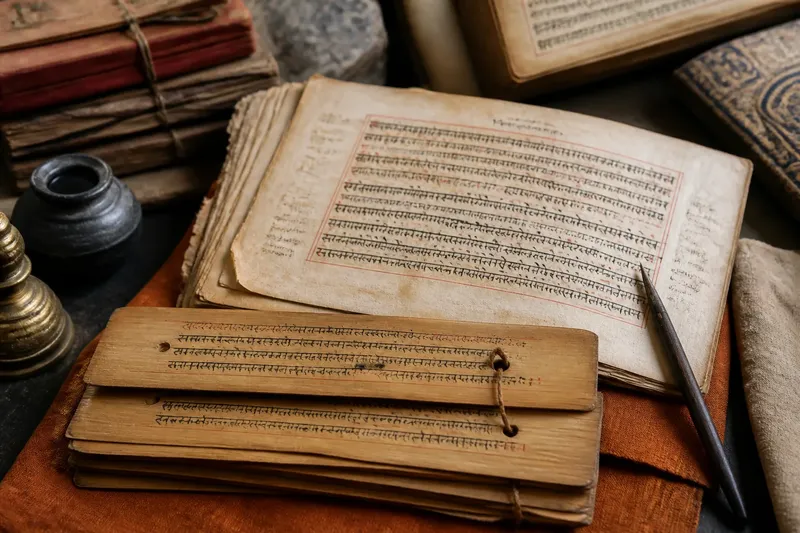
Palm leaf and paper are among the materials associated with Sanskrit manuscript traditions, but no single format applied everywhere. Local climate, available materials, writing practices and institutions influenced how manuscripts were made and kept. Leaves or sheets could be assembled, marked and stored according to local conventions.
The writing surface affected the practical work of reading and copying. A narrow leaf, for instance, could encourage lines that ran lengthwise; spacing and marks might help a reader distinguish verses, prose or commentary. Those arrangements helped readers find their place and helped copyists follow the text, but they do not work exactly like modern printed punctuation. A reader needs to attend to the conventions of the particular manuscript.
Think of the layout as a set of signposts on a familiar road: it can help a reader keep their place, but it does not tell them who travelled there or what they thought. The material form made some reading and copying practices possible while leaving others less convenient; it thus shaped how a text could be carried forward without dictating its meaning.
Condition also affects what can be transmitted. A missing section may result from later damage rather than an intentional ending. A stain or break can obscure letters without revealing the original wording. Separate what is visible on the surviving object from what a reader or editor infers about its earlier state.
4. Movement brought manuscripts into new settings
Teachers, students, religious communities, courts, libraries and travelling scholars could all take part in the circulation of Sanskrit manuscripts. A text might be copied where it was taught, carried to another centre and copied again. Its route need not have been a straight journey from an original home to a final destination.
Movement could change a manuscript’s audience without changing its subject. A work used in instruction might become part of a collection consulted by specialists; a text associated with one community could be read alongside works from another. New readers brought different questions, and a manuscript’s placement among other texts could influence how they approached it.
Imagine a teacher carrying a copy of a Sanskrit grammar to a new centre of learning. Students there use it alongside examples familiar from their own instruction, and a local copyist makes another version for later lessons. The resulting manuscript might retain the grammar’s structure while showing local spelling habits, annotations or a different arrangement of supplementary material. These are possible traces of the new setting, not proof of a single route.
A place name, ownership note or colophon may offer evidence of movement, but each clue needs interpretation. A manuscript’s present location may differ from where it was written, and a note may record only one stage in its history.
5. Commentary carried texts into new questions
Commentary could explain difficult wording, relate a passage to other authorities or apply a text to a particular intellectual problem. It might appear beside the main text, between its lines or in a separate work. In each form, commentary made interpretation visible and supported transmission through teaching and debate.
A commentator did not simply repeat the source. The explanation selected which terms needed attention, which ambiguities mattered and which other works should be considered. A later reader could encounter the original through that interpretive frame, while other commentaries might preserve distinct approaches.
When a manuscript contains both a base text and commentary, notice how their visual relationship works. Separate scripts, marginal placement or alternating sections may distinguish the voices, though the boundary can be subtle. Treating every note as part of the original risks confusing the text with a reader’s or teacher’s response.
6. Colophons and annotations record particular encounters
A colophon is a closing note that may identify a scribe, copying place, patron, date or completion of a work. Not every manuscript has one, and its contents vary. A colophon offers evidence about a particular copy’s production or ownership, not a complete account of the text’s origin or every stage of its circulation.
Annotations record other kinds of activity. A reader might add a correction, gloss, reference or mark for returning to a passage. Such traces show that a manuscript was handled and interpreted, but they do not always identify who wrote them or when. Different hands, inks or placements may help distinguish layers, though some marks remain uncertain.
Keep the inference modest. A note naming a place can connect a manuscript to that place at one moment, but it cannot by itself establish that the work was composed there. A correction may record a reader’s preferred wording rather than an older or more authoritative reading. The object preserves evidence; the reader’s task is to separate it from conclusions drawn about the object.
What can a Sanskrit manuscript tell you?
Does one manuscript preserve the original wording?
Not necessarily. A surviving copy may differ from its exemplar through deliberate changes, copying slips or damage, while other copies may preserve alternative readings. Comparing witnesses helps clarify the differences without assuming that one copy settles every question.
Does a new script mean the language changed?
No. Sanskrit could be written in different regional scripts, so a change of script alone does not show that the language changed. Consider the language, writing system and local manuscript features separately.
Can a colophon show where a work was composed?
A colophon may identify where a particular copy was made or provide information about its scribe or patron. That is evidence about the manuscript’s production, but it does not automatically locate the work’s composition.
Why do manuscripts include commentary or marginal notes?
Readers and teachers used explanations to clarify wording, connect a passage with other texts and support instruction. Notes can reveal how a manuscript was used, although their authorship and date may remain unclear.
Read the manuscript through its successive encounters
The Sanskrit manuscript’s history becomes clearer when you attend to both its wording and its physical traces. A changed script, a correction, a commentary or a colophon points to a different kind of encounter between text and reader. None tells the whole story alone, but together they can show how copying, material form, movement and interpretation kept a work available to new readers.
For a first close look, choose one feature and ask what it can support: identify the script without treating it as the language, distinguish a note from the main text, or read a colophon as evidence about that copy. The writing surface is part of Sanskrit manuscript transmission because it shaped how people could handle, read and copy a text; it is a clue to the work’s passage through time, not a complete account of it.