A First Visit to a Japanese Tea Gathering: What to Notice
A Japanese tea gathering becomes easier to follow when you notice its sequence, utensils and gestures without treating one host’s choices as universal.
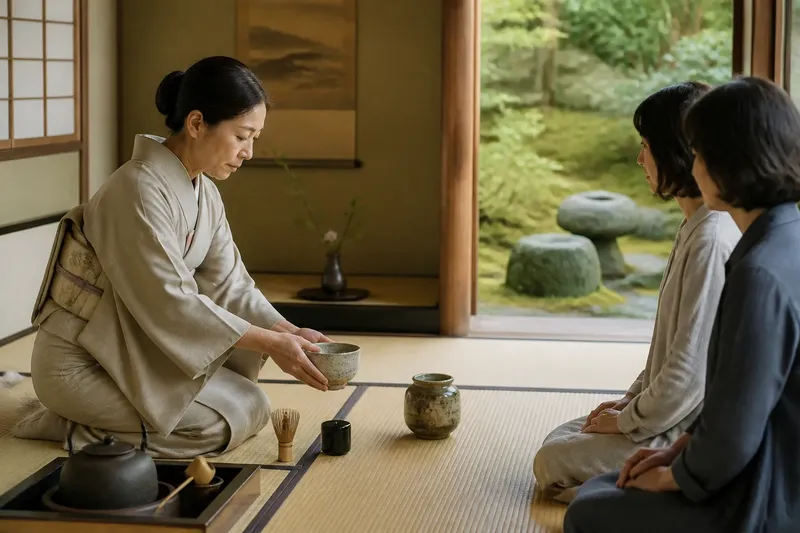
At a Japanese tea gathering, the host may turn a bowl before passing it to a guest, while a kettle murmurs nearby. If you are attending for the first time, the useful question is not whether you know every rule. It is what this particular gathering asks you to notice: its sequence, the objects in use and the gestures shared between host and guests.
Tea gatherings vary with the school, setting, season, occasion and people present. Some follow a formal structure; others are shorter or adapted for visitors. Treat what you see as a local practice rather than a template for all Japanese tea culture. When you are unsure, follow the host’s lead and allow the event to unfold before deciding what a gesture means.
What should I expect at a Japanese tea gathering?
Expect an organised encounter in which preparing and serving tea is part of a larger sequence of hospitality. Depending on the gathering, you may enter a tearoom, a garden-facing space or a room arranged for the occasion. There may be a waiting area, a brief welcome, a sweet, the preparation of tea and a moment to look at selected objects. Not every event includes each element, and the order can differ.
The event is not simply a demonstration of how to make a drink. The host attends to the room, utensils, timing and guests; guests respond through attention and considerate conduct. Quiet is common in formal settings, but this does not mean that every gathering is solemn or that conversation is always unwelcome. The host’s manner and the event’s instructions are better guides than assumptions about silence.
If you have been invited, ask the organiser beforehand whether there is a dress expectation, what footwear is appropriate and whether you should bring anything. A simple, tidy outfit is usually a sensible starting point. Avoid strong perfume, which can distract from the scent of tea, flowers, incense or the room’s materials.
How do I follow the sequence without assuming every gathering is the same?
Watch for transitions rather than trying to memorise a universal order. A host may prepare the space before guests arrive, receive them, handle a sweet, arrange utensils, prepare and serve tea, then clear away or close the gathering. The precise sequence depends on the occasion and style. One event might include a more extended meal; another may focus on a single serving of tea.
Notice what changes at each transition. The host may bring in an object, shift position, pause, or offer an indication that guests should move or respond. These actions help participants understand what is happening without a running explanation. Think of the sequence like a well-set table: the arrangement makes the next action easier to recognise, but another host may set it differently.
Follow direct guidance from the host or attendant. If instructions are spoken, listen for where to sit, when to bow, how to receive the bowl and where to place it afterwards. If other guests move first, watch discreetly and follow when appropriate. This is not a contest in which the quickest observer earns approval; an unhurried response is often more considerate than guessing.
For a first visit, it can help to separate what you see from what you infer. You might notice that a utensil is placed beside the bowl, then that the host pauses before serving. Those are observations. Deciding that the pause carries one fixed meaning would go further than the moment alone supports.
Which objects deserve attention, and what can they tell me?
Look at how objects are selected, placed and handled, not only at whether they appear old or elaborate. A tea bowl, whisk, scoop, kettle, water container, cloth, hanging scroll or flower arrangement may be part of the room’s composition. Some gatherings use a small number of objects; others bring several into view. Their importance comes from their role in this occasion as well as their appearance.
Notice materials and surfaces. A bowl may have an irregular rim, a glaze that gathers unevenly or a shape that feels suited to the hands. A bamboo scoop may be light and spare beside a heavier water jar. Rather than classifying each object from sight, attend to the practical questions: How does the host hold it? Where is it set down? Does it return to use, or is it displayed for guests to examine?
When the host invites guests to look at an object, listen for its name or context before handling it. If you are unsure whether touching is permitted, ask quietly or wait for an explicit invitation. Some objects are used during preparation, while others may be presented for appreciation. A close look is not permission to pick something up.
The room itself can also be read through its objects. A scroll, a branch or flower, the placement of utensils and the view from a doorway may relate to the occasion or season. You do not need to decode every choice. It is enough to notice how the host has made a particular arrangement and how it shapes the experience of sitting, watching and receiving tea.
How should I behave when receiving tea?
Start with the host’s directions, since the handling of the bowl and other gestures can vary. In some formal settings, a guest acknowledges the host and other participants, receives the bowl with care, turns it before drinking, and returns it in an indicated position. Elsewhere, the host or attendant may explain a simplified way to take part. Follow the version offered at your gathering rather than applying a rule remembered from another setting.
Handle the bowl gently, using both hands if that is what you are shown. Avoid reaching across another guest or interrupting the host while utensils are in use. If you need to adjust your seat, wait for a pause where possible. These small choices keep attention on the shared sequence and reduce the chance of disrupting someone else’s movement.
Say thank you when appropriate, and respond naturally if the host asks a question. You do not need to perform expertise or describe every detail. If you make a mistake, a brief apology and a willingness to follow the next instruction are usually more helpful than a long explanation.
Imagine you are invited to a small gathering where the host demonstrates how to turn the bowl before drinking. You watch the first guest, repeat the gesture gently when your turn comes, and return the bowl where the host indicates. The observable result is that you take part in the offered sequence without claiming that every tea gathering uses the same movement.
What questions should I ask before or during the gathering?
Should I learn the etiquette before I arrive?
Learn any instructions the organiser has provided, but you do not need to memorise a full etiquette system. Ask about practical matters such as footwear, seating, photography and whether the gathering is participatory or mainly for observation.
Can I take photographs?
Ask before taking photographs, and do not assume that permission for one moment extends to the whole event. A host may ask guests to keep cameras away so that attention stays on the gathering and its participants.
Is it rude if I do not know a gesture?
Not knowing a gesture is not the same as refusing to be considerate. Watch the host, follow clear directions and ask quietly if a practical instruction is unclear.
What if I cannot sit comfortably in the expected position?
Tell the organiser or host discreetly before the gathering, if possible. They may be able to suggest another seat or explain how to participate comfortably; avoid forcing a position that causes pain.
How can I observe respectfully without turning the gathering into a lesson?
Pay attention to the people as well as the utensils. The host’s choices are responses to this room, these guests and this occasion; they are not merely clues to be collected. Notice how participants make room for one another, how the host manages pauses and how objects move between preparation and service.
Keep questions brief and well timed. A pause may be part of the event, so wait until the host invites conversation or a natural opening appears. Questions about an object’s use or a particular gesture can be more helpful than asking someone to explain an entire tradition on the spot. If a detailed explanation is offered, listen without treating it as a definitive account of every school or gathering.
Afterwards, write down what you actually observed: the order of events, the objects used, the instructions given and the moments you found surprising. Keep interpretation separate. For example, note that the host placed a flower near the alcove before guests entered; do not turn that single observation into a rule about all seasonal arrangements.
A Japanese tea gathering is easiest to understand when you let its particular form remain particular. Notice the sequence, handle objects only as invited, and follow the host’s cues. That approach will serve you better than trying to reproduce gestures from memory, and it leaves room to appreciate how another host might arrange the same practice differently.